

First Home Buyer Home Loan: Everything You Need to Know
Buying your first property starts with understanding how a first home buyer home loan works. These loans are designed to help Australians enter the property market with lower deposits, flexible lending criteria, and access to government incentives.
Whether you're saving your deposit or ready to apply, choosing the right home loan can significantly impact your borrowing power, repayments, and long-term financial position.
Quick Answer
A first home buyer home loan is a mortgage designed for people purchasing their first property. It typically offers low deposit options (from 5%), access to government schemes, and flexible features. Choosing the right loan depends on your income, deposit size, and long-term goals.
How First Home Buyer Home Loans Work in Australia

A first home buyer home loan allows you to borrow money from a lender to purchase your first property, with the loan secured against the property itself.
Key components include:
-
Loan amount – The amount you borrow
-
Deposit – Typically 5%–20% of the property price
-
Interest rate – Fixed or variable
-
Loan term – Usually 25–30 years
Most first home buyers will need to demonstrate:
-
Stable income
-
Genuine savings
-
Good credit history
-
Ability to meet repayments
If you're just starting your journey, our full first home buyer guide within the broader first home buyers Australia resource hub explains the entire process step-by-step.
Types of Home Loans for First Home Buyers
Variable Rate Home Loans
-
Interest rate can change over time
-
More flexibility (extra repayments, redraw)
-
Often preferred for long-term flexibility
Fixed Rate Home Loans
-
Locked interest rate for a set period (1–5 years)
-
Predictable repayments
-
Limited flexibility
Split Loans
-
Combination of fixed and variable
-
Balance between stability and flexibility
Low Deposit Home Loans
-
Available from 5% deposit
-
Often used with government schemes
-
May avoid Lenders Mortgage Insurance (LMI)
How Much Deposit Do You Need?
The required deposit depends on your financial situation and loan structure.
Example Scenario (Australia)
-
Property Price: $650,000
-
5% Deposit: $32,500
-
10% Deposit: $65,000
-
20% Deposit: $130,000
If your deposit is under 20%, you may need to pay Lenders Mortgage Insurance (LMI) — unless you qualify for a government scheme.
Government Support for First Home Buyers
Several schemes are available to help reduce upfront costs:
First Home Guarantee (FHBG)
-
Buy with as little as 5% deposit
-
No LMI required
-
Government guarantees part of the loan
First Home Owner Grant (FHOG)
-
Lump sum payment (varies by state)
-
Typically for new builds
Stamp Duty Concessions
-
Reduced or waived stamp duty
-
Based on property value and location
These incentives can significantly improve affordability and reduce the time needed to enter the market.
Mortgage Broker Insight
Many first home buyers focus solely on interest rates — but that’s only one piece of the puzzle.
In reality, lenders assess:
-
Income structure (especially for self-employed borrowers)
-
Spending habits
-
Borrowing capacity calculations
-
Policy differences between lenders
A common strategy is structuring your loan to maximise borrowing capacity while keeping repayments manageable.
Working with an experienced broker like Chris Berry from Find A Better Rate (18+ years experience) ensures you're matched with lenders that suit your specific situation — not just the lowest advertised rate.
Costs Involved in a First Home Buyer Loan
Beyond your deposit, you’ll need to budget for additional costs:
Upfront Costs
-
Stamp duty (if applicable)
-
Conveyancing/legal fees
-
Building and pest inspections
-
Loan application or settlement fees
Ongoing Costs
-
Loan repayments
-
Council rates
-
Insurance (home & contents)
-
Maintenance
Comparing the Best First Home Buyer Loans
Choosing the best first home buyer loans isn’t about picking the lowest rate — it’s about finding the right structure.
Key Factors to Compare
-
Interest rate (comparison rate included)
-
Loan features (offset, redraw)
-
Fees and charges
-
Flexibility
-
Lender policy
Example Comparison
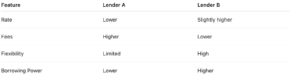
In many cases, a slightly higher rate can result in greater borrowing capacity or better long-term flexibility.
Common Mistakes to Avoid
1. Focusing Only on Interest Rates
Ignoring loan features and flexibility can cost more long-term.
2. Not Understanding Borrowing Capacity
Online calculators are a guide — lender policies vary significantly.
3. Overstretching Your Budget
Just because you can borrow more doesn’t mean you should.
4. Skipping Pre-Approval
This can delay your purchase or cause you to miss opportunities.
5. Not Using Available Government Schemes
Many first home buyers miss out simply due to lack of awareness.
Real-World Example: First Home Buyer Loan
Scenario:
-
Income: $95,000 (single applicant)
-
Deposit: $50,000
-
Property Price: $600,000
Outcome:
-
Loan: $550,000
-
Deposit: ~8%
-
Eligible for First Home Guarantee
-
No LMI required
This significantly reduces upfront costs and allows earlier entry into the market.
Check Your Borrowing Capacity
Before choosing a loan, it’s important to understand how much you can borrow.
Use tools like:
These give a starting point — but a tailored assessment will provide a far more accurate result.
Speak with a Mortgage Broker
If you're serious about buying your first home, getting expert guidance can save time, money, and stress.
Chris Berry
Find A Better Rate Home Loans
18+ years experience helping Australian borrowers
 Phone: 0477 212 840
 Email: chris@findabetterrate.com.au
Get tailored advice and access to a wide range of lenders suited to your situation.
First Home Buyer Home Loan: Everything You Need to Know
Buying your first property starts with understanding how a first home buyer home loan works. These loans are designed to help Australians enter the property market with lower deposits, flexible lending criteria, and access to government incentives.
Whether you're saving your deposit or ready to apply, choosing the right home loan can significantly impact your borrowing power, repayments, and long-term financial position.
Quick Answer
A first home buyer home loan is a mortgage designed for people purchasing their first property. It typically offers low deposit options (from 5%), access to government schemes, and flexible features. Choosing the right loan depends on your income, deposit size, and long-term goals.
How First Home Buyer Home Loans Work in Australia
A first home buyer home loan allows you to borrow money from a lender to purchase your first property, with the loan secured against the property itself.
Key components include:
-
Loan amount – The amount you borrow
-
Deposit – Typically 5%–20% of the property price
-
Interest rate – Fixed or variable
-
Loan term – Usually 25–30 years
Most first home buyers will need to demonstrate:
-
Stable income
-
Genuine savings
-
Good credit history
-
Ability to meet repayments
If you're just starting your journey, our full first home buyer guide within the broader first home buyers Australia resource hub explains the entire process step-by-step.
Types of Home Loans for First Home Buyers
Variable Rate Home Loans
-
Interest rate can change over time
-
More flexibility (extra repayments, redraw)
-
Often preferred for long-term flexibility
Fixed Rate Home Loans
-
Locked interest rate for a set period (1–5 years)
-
Predictable repayments
-
Limited flexibility
Split Loans
-
Combination of fixed and variable
-
Balance between stability and flexibility
Low Deposit Home Loans
-
Available from 5% deposit
-
Often used with government schemes
-
May avoid Lenders Mortgage Insurance (LMI)
How Much Deposit Do You Need?
The required deposit depends on your financial situation and loan structure.
Example Scenario (Australia)
-
Property Price: $650,000
-
5% Deposit: $32,500
-
10% Deposit: $65,000
-
20% Deposit: $130,000
If your deposit is under 20%, you may need to pay Lenders Mortgage Insurance (LMI) — unless you qualify for a government scheme.
Government Support for First Home Buyers
Several schemes are available to help reduce upfront costs:
First Home Guarantee (FHBG)
-
Buy with as little as 5% deposit
-
No LMI required
-
Government guarantees part of the loan
First Home Owner Grant (FHOG)
-
Lump sum payment (varies by state)
-
Typically for new builds
Stamp Duty Concessions
-
Reduced or waived stamp duty
-
Based on property value and location
These incentives can significantly improve affordability and reduce the time needed to enter the market.
Mortgage Broker Insight
Many first home buyers focus solely on interest rates — but that’s only one piece of the puzzle.
In reality, lenders assess:
-
Income structure (especially for self-employed borrowers)
-
Spending habits
-
Borrowing capacity calculations
-
Policy differences between lenders
A common strategy is structuring your loan to maximise borrowing capacity while keeping repayments manageable.
Working with an experienced broker like Chris Berry from Find A Better Rate (18+ years experience) ensures you're matched with lenders that suit your specific situation — not just the lowest advertised rate.
Costs Involved in a First Home Buyer Loan
Beyond your deposit, you’ll need to budget for additional costs:
Upfront Costs
-
Stamp duty (if applicable)
-
Conveyancing/legal fees
-
Building and pest inspections
-
Loan application or settlement fees
Ongoing Costs
-
Loan repayments
-
Council rates
-
Insurance (home & contents)
-
Maintenance
Comparing the Best First Home Buyer Loans
Choosing the best first home buyer loans isn’t about picking the lowest rate — it’s about finding the right structure.
Key Factors to Compare
-
Interest rate (comparison rate included)
-
Loan features (offset, redraw)
-
Fees and charges
-
Flexibility
-
Lender policy
Example Comparison
In many cases, a slightly higher rate can result in greater borrowing capacity or better long-term flexibility.
Common Mistakes to Avoid
1. Focusing Only on Interest Rates
Ignoring loan features and flexibility can cost more long-term.
2. Not Understanding Borrowing Capacity
Online calculators are a guide — lender policies vary significantly.
3. Overstretching Your Budget
Just because you can borrow more doesn’t mean you should.
4. Skipping Pre-Approval
This can delay your purchase or cause you to miss opportunities.
5. Not Using Available Government Schemes
Many first home buyers miss out simply due to lack of awareness.
Real-World Example: First Home Buyer Loan
Scenario:
-
Income: $95,000 (single applicant)
-
Deposit: $50,000
-
Property Price: $600,000
Outcome:
-
Loan: $550,000
-
Deposit: ~8%
-
Eligible for First Home Guarantee
-
No LMI required
This significantly reduces upfront costs and allows earlier entry into the market.
Check Your Borrowing Capacity
Before choosing a loan, it’s important to understand how much you can borrow.
Use tools like:
These give a starting point — but a tailored assessment will provide a far more accurate result.
Speak with a Mortgage Broker
If you're serious about buying your first home, getting expert guidance can save time, money, and stress.
Chris Berry
Find A Better Rate Home Loans
18+ years experience helping Australian borrowers
Phone: 0477 212 840 Email: chris@findabetterrate.com.au
Get tailored advice and access to a wide range of lenders suited to your situation.
Meet Chris

Chris Berry
Owner of Find A Better Rate Home Loans
Hi, I’m Chris Berry, an independent mortgage broker with over 18 years of experience helping Australians make confident, informed home loan decisions.
I’m the founder of Find A Better Rate Home Loans, where I specialise in assisting first home buyers, refinancers, investors, and self-employed borrowers. With access to 40+ lenders, I compare options across the market to find loan solutions that genuinely suit each client’s situation, not just the most convenient option.
My approach is straightforward: clear explanations, honest advice, and hands-on support from start to finish. I focus on educating clients, cutting through jargon, and making the lending process as smooth and stress-free as possible.
If you’re looking for experienced, unbiased guidance and a broker who puts your interests first, I’d be happy to help.
Our Reviews
We pride ourselves on being brokers you can actually trust, from the initial consultation through to annual reviews that we perform years after your settlement, our tailored services and relationship focus is built to last.
Need proof that we are one of Melbourne’s best mortgage brokerages? Don’t just take our word for it – we have hundreds of positive Google reviews from real clients so you can rest assured you’re making the right choice with choosing Find A Better Rate Home Loans.
Frequently Asked Questions

Get in Touch
98% Approval Rate
18 Years Experience
18 Years Experience
98% Approval Rate
Latest Articles from Find A Better Rate
-
Is Refinancing Still Worth It in 2026? | Australia Guide
A Practical Australian Guide to Refinance Decisions Refinancing a home loan has never been just about chasing the lowest interest rate. It is a decision that involves costs, loan structure, lender rules, and your personal plans. In 2026, many Australian borrowers are reviewing loans taken out in a very different rate environment. At the same…
-
Aussie home owners just got $82,000 richer on average
What a way to start the new year! After a strong 12 months in the property market, plenty of homeowners around the nation are now a whole lot wealthier. And their newfound increase in home equity has opened up some exciting possibilities for 2026. Your home isn’t just a place to live in, it could…
-
Happy New Year! Let’s discuss some potential 2026 goals
There’s nothing quite like a New Year’s resolution to fire you up for another lap around the sun. Whether you’re looking to buy your first home, save on your mortgage, or leverage the equity in your current position, here are three resolutions to consider for 2026. So long, 2025 … You know what? We’ve got…


-
Is Refinancing Still Worth It in 2026? | Australia Guide
A Practical Australian Guide to Refinance Decisions Refinancing a home loan has never been just about chasing the lowest interest rate. It is a decision that involves costs, loan structure, lender rules, and your personal plans. In 2026, many Australian borrowers are reviewing loans taken out in a very different rate environment. At the same…
-
Aussie home owners just got $82,000 richer on average
What a way to start the new year! After a strong 12 months in the property market, plenty of homeowners around the nation are now a whole lot wealthier. And their newfound increase in home equity has opened up some exciting possibilities for 2026. Your home isn’t just a place to live in, it could…
-
Happy New Year! Let’s discuss some potential 2026 goals
There’s nothing quite like a New Year’s resolution to fire you up for another lap around the sun. Whether you’re looking to buy your first home, save on your mortgage, or leverage the equity in your current position, here are three resolutions to consider for 2026. So long, 2025 … You know what? We’ve got…
-
Season’s greetings! Here’s to a well-earned summer break
As the Christmas and New Year’s festive season rolls around, we want to take a moment to sincerely thank you for your trust and support throughout 2025. Fortunately, we had a bit more to smile about this year, with three RBA rate cuts and national property prices increasing by 8.7%. That said, 2025 wasn’t without its…

-
Is Refinancing Still Worth It in 2026? | Australia Guide
A Practical Australian Guide to Refinance Decisions Refinancing a home loan has never been just about chasing the lowest interest rate. It is a decision that involves costs, loan structure, lender rules, and your personal plans. In 2026, many Australian borrowers are reviewing loans taken out in a very different rate environment. At the same…
-
Aussie home owners just got $82,000 richer on average
What a way to start the new year! After a strong 12 months in the property market, plenty of homeowners around the nation are now a whole lot wealthier. And their newfound increase in home equity has opened up some exciting possibilities for 2026. Your home isn’t just a place to live in, it could…
Secure Competitive Home Loan Rates with Trusted Mortgage Lenders
Select from 35+ Trusted Lenders and Tailored Home Loan Solutions