


If you’re self-employed, freelance, or run your own business, traditional home loan requirements can feel nearly impossible to meet. Most lenders ask for payslips, tax returns, group certificates, and long financial histories. For many business owners, these documents either don’t exist in the same format or don’t reflect the true earning capacity of the business. That’s where a low doc home loan comes in — a flexible, realistic solution for borrowers who have genuine income but limited ability to provide standard financial paperwork.
What Is a Low Doc Home Loan?
A low doc home loan (low documentation loan) allows eligible borrowers to apply for a home loan using alternative income verification rather than traditional PAYG proof.
Instead of payslips or employer letters, lenders may accept:
- Business bank statements
- BAS statements
- Accountant-signed declarations of income
- Profit-and-loss summaries
- ABN and GST registration details
The loan itself functions much like any normal mortgage. You still choose between fixed or variable rates, interest-only or principal-and-interest repayments, and depending on the lender, you may access features such as redraw and offset. The main difference is the paperwork needed at application, and the way lenders assess your earning capacity.
Who Do Low Doc Home Loans Suit?
Low-doc lending is designed for borrowers who are financially capable but can’t provide conventional employment documentation. These borrowers often include:
- Self-employed individuals who generate income outside PAYG wages
- Contractors and freelancers with fluctuating earnings
- Start-up business owners still building financial history
- Business operators recently transitioned from PAYG
- Individuals who can demonstrate income but not through formal financial statements
Many self-employed Australians experience inconsistent income on paper due to seasonal work, invoicing cycles, tax timing, or reinvesting profits back into their business. Even if income is strong, it may not be reflected cleanly in tax returns. A low doc home loan helps fill this gap by assessing income through alternative methods.
Low Doc Home Loan Requirements
Every lender sets their own criteria, but common low doc home loan requirements include:
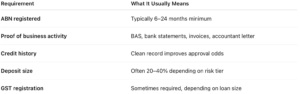
Unlike full-doc home loans, low doc applications focus more on real-time cash flow and business performance rather than two full years of tax submissions. This means a business with strong turnover, consistent invoices, and active financial activity may qualify even if formal records are still in progress.
Low Doc Home Loan Rates: What to Expect
Because low doc home loans involve higher risk to the lender, interest rates may sit above standard mortgage rates. This is not always significant, but borrowers should understand why the difference exists.
Rate factors may include:
- Size of deposit (larger deposits reduce risk)
- Business stability and trading duration
- Credit score and repayment history
- Type of documentation provided
- Loan-to-value ratio (LVR)
- Whether the loan is for owner-occupier or investment use
Many low doc borrowers begin with a slightly higher interest rate, then refinance to a standard loan after they achieve two solid financial years and accountant-confirmed documentation. This approach gives immediate access to property ownership while also opening the opportunity for rate reduction later.
The Best Low Doc Home Loans in Australia: What to Compare
When comparing the best low doc home loans Australia has available, consider:
- Interest rate vs comparison rate
- Maximum borrowing amount and LVR caps
- Offset account access and redraw features
- Application or risk fees
- Flexibility of accepted documentation
- Refinancing opportunities after 12–24 months
Some lenders may allow business bank statements alone, while others may require BAS and an accountant letter. If your income is variable, flexibility in documentation can make a big difference in the approval outcome.
Pros and Cons: Is Low Doc the Right Fit?
Advantages
- Accepts alternative income verification
- Designed for business owners and flexible earners
- Offers similar features to full-doc loans (offset, redraw, fixed/variable)
- Can provide a pathway to refinancing at lower rates down the track
- Helps borrowers qualify sooner rather than waiting for full tax cycle totals
Considerations
- Rates and fees can sit slightly higher
- Larger deposits are often required for approval
- Some lenders apply loan amount limits based on industry type or income volatility
- Not all banks offer low doc lending, limits choice without a broker
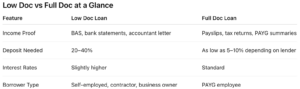
Low Doc vs Full Doc at a Glance
Is a Low Doc Home Loan Right for You?
You may be a strong candidate if:
- You run a business with consistent revenue
- You have a solid deposit or equity to contribute
- You need a loan approval method that reflects actual cash flow
- You prefer to secure property now rather than delaying another full financial year
- You’re open to refinancing later to secure lower rates
For many business owners, this loan type acts as a bridge. You gain the benefit of buying now, while retaining the ability to convert to a full-doc loan when your accounting records are fully established.
Next Steps
If you’re self-employed and ready to start exploring your options:
- Collect your latest business financial documents
- Compare low doc home loan rates and features
- Consider your refinancing strategy for the next few years
- Speak with a broker experienced in low doc lending
A low doc home loan can provide the flexibility and access needed for successful property purchasing, without waiting for perfect tax timing or traditional documentation.
Our Reviews
We pride ourselves on being brokers you can actually trust, from the initial consultation through to annual reviews that we perform years after your settlement, our tailored services and relationship focus is built to last.
Need proof that we are one of Melbourne’s best mortgage brokerages? Don’t just take our word for it – we have hundreds of positive Google reviews from real clients so you can rest assured you’re making the right choice with choosing Find A Better Rate Home Loans.
Frequently Asked Questions

Get in Touch
98% Approval Rate
18 Years Experience
18 Years Experience
98% Approval Rate
Latest Articles from Find A Better Rate
-
Is Refinancing Still Worth It in 2026? | Australia Guide
A Practical Australian Guide to Refinance Decisions Refinancing a home loan has never been just about chasing the lowest interest rate. It is a decision that involves costs, loan structure, lender rules, and your personal plans. In 2026, many Australian borrowers are reviewing loans taken out in a very different rate environment. At the same…
-
Aussie home owners just got $82,000 richer on average
What a way to start the new year! After a strong 12 months in the property market, plenty of homeowners around the nation are now a whole lot wealthier. And their newfound increase in home equity has opened up some exciting possibilities for 2026. Your home isn’t just a place to live in, it could…
-
Happy New Year! Let’s discuss some potential 2026 goals
There’s nothing quite like a New Year’s resolution to fire you up for another lap around the sun. Whether you’re looking to buy your first home, save on your mortgage, or leverage the equity in your current position, here are three resolutions to consider for 2026. So long, 2025 … You know what? We’ve got…



-
Is Refinancing Still Worth It in 2026? | Australia Guide
A Practical Australian Guide to Refinance Decisions Refinancing a home loan has never been just about chasing the lowest interest rate. It is a decision that involves costs, loan structure, lender rules, and your personal plans. In 2026, many Australian borrowers are reviewing loans taken out in a very different rate environment. At the same…
-
Aussie home owners just got $82,000 richer on average
What a way to start the new year! After a strong 12 months in the property market, plenty of homeowners around the nation are now a whole lot wealthier. And their newfound increase in home equity has opened up some exciting possibilities for 2026. Your home isn’t just a place to live in, it could…
-
Happy New Year! Let’s discuss some potential 2026 goals
There’s nothing quite like a New Year’s resolution to fire you up for another lap around the sun. Whether you’re looking to buy your first home, save on your mortgage, or leverage the equity in your current position, here are three resolutions to consider for 2026. So long, 2025 … You know what? We’ve got…
-
Season’s greetings! Here’s to a well-earned summer break
As the Christmas and New Year’s festive season rolls around, we want to take a moment to sincerely thank you for your trust and support throughout 2025. Fortunately, we had a bit more to smile about this year, with three RBA rate cuts and national property prices increasing by 8.7%. That said, 2025 wasn’t without its…

-
Is Refinancing Still Worth It in 2026? | Australia Guide
A Practical Australian Guide to Refinance Decisions Refinancing a home loan has never been just about chasing the lowest interest rate. It is a decision that involves costs, loan structure, lender rules, and your personal plans. In 2026, many Australian borrowers are reviewing loans taken out in a very different rate environment. At the same…
-
Aussie home owners just got $82,000 richer on average
What a way to start the new year! After a strong 12 months in the property market, plenty of homeowners around the nation are now a whole lot wealthier. And their newfound increase in home equity has opened up some exciting possibilities for 2026. Your home isn’t just a place to live in, it could…
Secure Competitive Home Loan Rates with Trusted Mortgage Lenders
Select from 35+ Trusted Lenders and Tailored Home Loan Solutions